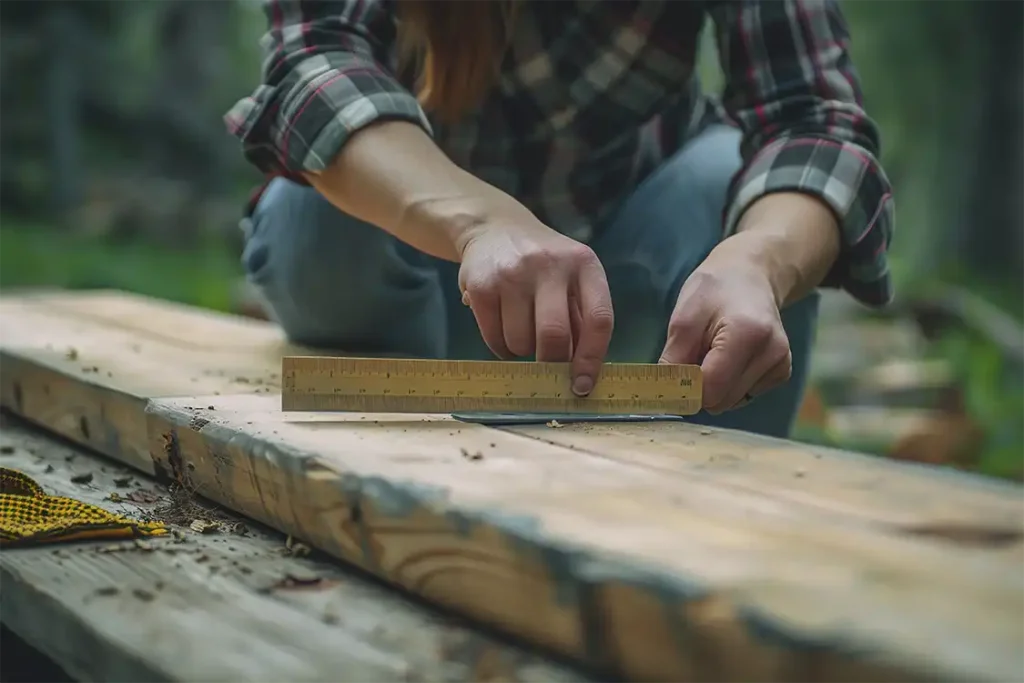
Treated Pine Sleepers Central Coast projects usually start the same way. A backyard needs taming, a garden bed needs defining, or a slope needs holding back. So sleepers are the cheapest material that does all three.
Central Coast homeowners and landscapers both use them, because the same product covers a single garden border through to multi-level terracing. So here is what is worth knowing before heading to the treated pine range.
What Are Treated Pine Sleepers?
Lengths of plantation pine put through a chemical preservation process. As a result they resist decay, termites, borers and fungal attack, which raw timber in soil does not.
Most Australian treated pine uses CCA, or Copper Chrome Arsenate, and that is what gives it the green tint. The hazard class matters more than the chemistry though. The NSW EPA treated timber chart sets out what each class covers, so start there.
H4 is rated for outside, in-ground use against severe decay, borers and termites. In addition, its typical uses on that chart are landscaping timbers, fence posts and pergola posts. H5 sits a step higher, however, rated for in-ground use and contact with fresh water against very severe decay.
Worth noting that the chart lists retaining walls among H5’s typical uses rather than H4’s. So for a bed or a border, H4 is the class. For a retaining wall, ask about H5, which the yard supplies on request. The WoodSolutions wood products library covers the species and product types behind those classes.
Common Uses for Treated Pine Sleepers on the Central Coast
Five jobs account for most of the treated pine that leaves the yard, and each one wants a different profile.
Retaining Walls
The most common use by a long way. Sleepers simply stack horizontally between vertical posts, and that is why a treated pine wall goes up faster and costs less than block or stone.
This is also the use where the hazard class matters most, because the NSW EPA chart lists retaining walls under H5 rather than H4. So ask for H5 and expect it to be ordered in.
Which Sleeper Size For A Retaining Wall?
Height and what sits behind it decide that, so a low garden terrace and a wall holding up a driveway are not the same job. The thicker 200 x 100mm sleeper is the one that spans furthest between posts, while 150 x 50mm suits a single-tier garden terrace. So bring the height and the length, and the team will work it through.
Raised Garden Beds
Here the sleepers are only the frame, because the soil does the growing. Lifting a bed clear of the ground also improves drainage and gives roots a defined depth to work in.
Smaller profiles suit a single-tier bed, while the deeper sizes suit anything close to waist height. For a bed growing food, ask for ACQ rather than CCA, for the reasons set out below.
Steps and Path Edging
Laid flat on sloped ground, sleepers make solid garden steps without any formwork at all. The sleeper width sets the tread, which is why a 200mm sleeper suits a step and a 125mm one does not.
Along a path the same sleeper on its edge holds mulch and soil back off the paving. That is the cheapest fix for a path that keeps disappearing under the garden.
Garden Borders
Usually the smallest profiles do this one, dividing lawn from bed in a single straight run. Upkeep is close to nothing, because there is nothing sitting above ground level to weather.
Timber will not take a curve, though, and that is the one real limit. Where the bed curves or a thinner line is wanted, steel garden edging is the comparison worth making.
Steps and Path Edging
With basic tools and some planning, sleepers cut down into custom planters and freestanding feature walls. This is where the other profiles earn their place.
Round logs, slabs and wing splits each give a different face to the same job, so the choice is aesthetic as much as structural. A slab at 100mm x 2.4m makes a bench or a step tread as readily as it makes a wall.
Do You Need Council Approval for a Retaining Wall in NSW?
Sometimes, and the conditions are more specific than most people expect. The NSW Planning Portal guidance on earthworks, retaining walls and structural support sets out what State policy requires for the work to be exempt from consent.
The Five Conditions
All five have to be met, and missing one puts the work back into the approval system:
- Not on or in a heritage item or a draft heritage item, and in a heritage conservation area it goes in the rear yard.
- Then at least 40 metres from a body of natural water.
- No redirecting of surface or ground water.
- Also no sediment sent onto an adjoining property.
- At least 2 metres horizontally from any other retaining wall on the site.
Why Height Is Not On That List
However, notice what is missing from that list. There is no height limit on it, because heights come from elsewhere. So for anything past a low border, ring Central Coast Council on (02) 4306 7900 before breaking ground.
Two Details That Decide How Long It Lasts
Two build details matter whatever the height. Galvanised or stainless steel fasteners resist corrosion at the joins, for one. Drainage at the base of the wall relieves water pressure from the soil behind it, and that pressure is what shortens the life of the timber.
Are Treated Pine Sleepers Safe Near Vegetable Gardens?
The regulators have a view worth knowing here. The NSW EPA treated timber chart tells readers to select the right class for the job and, where possible, to choose an arsenic-free alternative.
Nationally the position is narrower than most people assume. The APVMA review of arsenic timber treatments found CCA is not permitted for garden furniture, picnic tables, exterior seating, children’s play equipment, patio and domestic decking or handrails. Frequent and intimate contact is the reason given, particularly by children. It stays permitted for fence posts, fence palings and other structural timbers where frequent contact is unlikely.
That review does not address food crops either way, though. So the practical answer for a vegetable bed is to ask for ACQ, which is Alkaline Copper Quaternary and carries no arsenic. The yard supplies it on request, so raise it when the order goes in.
The soil matters as much as the frame. What to fill a raised garden bed with covers the depths and the products, and the organic top dress soil range is where the mixes sit.
Treated Pine Sizes Available at Kincumber Sand & Soil
Sleepers in H4 CCA run across nine sizes, six of them in 2.4m and three in 3.0m:
- 2.4m: 125 x 75mm, 150 x 50mm, 150 x 75mm, 200 x 50mm, 200 x 75mm, 200 x 100mm
- 3.0m: 200 x 50mm, 200 x 75mm, 200 x 100mm
Three other profiles sit alongside them as well. Round logs come in 100mm, 125mm and 150mm, at 1.8m or 2.4m. Slabs, meanwhile, come in 100mm x 2.4m. Wing splits come in 125mm x 2.4m.
H5 and ACQ are available on request, and other sizes can be ordered in with notice. For cement, damp course or fasteners, the building supplies range covers the rest of the job from the one yard.
Visit the Kincumber Yard for Expert Advice
Kincumber Sand & Soil has supplied the Central Coast building and landscaping trade for more than 30 years, family owned and operated throughout. Because the yard at 4 Kerta Rd, Kincumber is a drive-through, a trailer loads without reversing.
So bring the measurements and the team will sort the sizing and the count. A weekend retaining wall and a full backyard rebuild get the same conversation. Browse the complete range of landscape supplies in Kincumber online, or walk the yard instead.
Ready to Get Started?
Ready to work out a count? Then contact Kincumber Sand & Soil or call the team on (02) 4368 1252. Open Monday to Friday 6:30am to 4pm and Saturday 6:30am to 12pm.