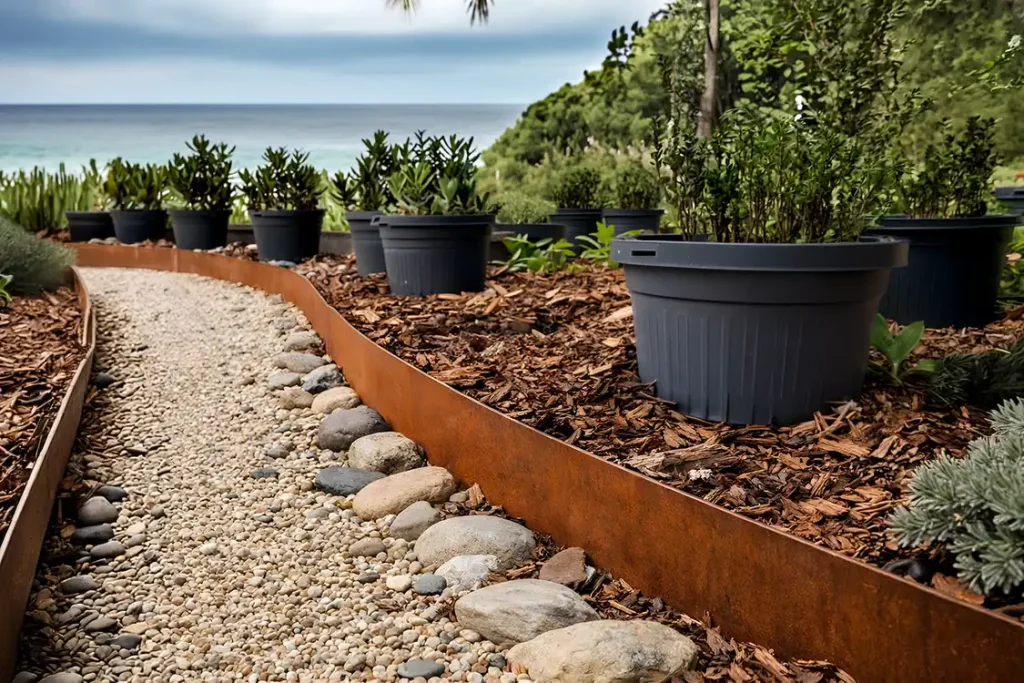
Every garden project reaches a point where the edges decide how the whole thing reads. Crisp borders between lawn, beds and paths make a space look deliberate. Crumbling ones make good planting look neglected. So steel garden edging on the Central Coast has become the usual answer for homeowners who want that line to hold without annual upkeep.
However, steel is not one product, and local conditions do not suit every version of it. So this covers what the material does, which system the yard stocks, the levels it should finish at and the one site condition worth checking before ordering. The Shapescaper range is where it all sits.
What Is Steel Garden Edging?
A rigid border set at ground level to hold two surfaces apart. In practice it holds mulch and soil in place and stops lawn runners reaching the beds. It also defines a path edge and gives a garden a clean line.
Plastic is the version that fails first, because sun makes it brittle and it warps out of line. Timber and steel both last, though, so choosing between them comes down to shape and look rather than durability. Treated pine suits straight runs and a heavier, softer finish. Steel takes curves, sits thinner in the ground and holds a sharper line.
How Weathering Steel Behaves In A Coastal Climate
What Makes The Patina Form?
It needs the weather to do its work, and that is the part most buyers miss. BlueScope describes REDCOR weathering steel as developing a stable oxide layer on the surface known as the patina. That layer forms under alternating wet and dry conditions, and its colour keeps changing organically over time.
Two conditions come attached. BlueScope’s technical bulletin on REDCOR states the patina needs bold exposure to develop. It also advises against weathering steel at locations where wet and dry cycles do not regularly occur. So a run sitting under dense groundcover in permanent shade works against the material.
Does Salt Air Actually Suit It?
Not everywhere, and this is the condition that carries real weight here. That same bulletin advises against weathering steel in marine environments with high salt deposition rates. It adds that a workable proximity to marine influence depends on wind direction and strength, the type of marine influence and local topography. In other words, a block at Copacabana facing open surf deserves a conversation before ordering, while one further back at Erina or Kincumber sits in a much milder exposure.
Wet and dry cycling, meanwhile, is not in short supply. Bureau of Meteorology climate averages for Gosford put March as the wettest month at 214.9mm and September as the driest at 63.0mm, so the local year swings between the two.
Shapescaper Steel Garden Edging: Australian Made and Built to Last
Kincumber Sand & Soil stocks the Shapescaper steel garden edging and landscaping system, manufactured in Australia from Australian BlueScope steel. Four specifications from its product page are worth knowing before comparing it against anything else:
- Thickness starts at a minimum of 2.0mm across the edging products, while planters use a minimum of 2.5mm. For heavy duty edging applications the page recommends 2.5mm as well. That gauge is what stops a long run bowing between its fixings.
- Eight profile heights run from 75mm up to 590mm. As a result one range covers a simple lawn border, a raised planter and multi-level terracing without swapping systems partway through a job.
- Components connect through pre-drilled holes, and all required parts come supplied. The system needs no welding and no specialist tools either, so a confident DIY installation is realistic rather than aspirational.
- A 10 year structural warranty applies across the products, and the range suits commercial installations as well as domestic ones.
What Height Should The Edging Finish At?
Flush with whatever sits either side of it. Central Coast Council’s landscaping standard drawings include a garden edges detail, SD1015, and it sets the levels plainly. Mown turf areas finish flush with the edging, and mulched garden areas finish flush with the adjacent surface levels of the edging.
Those drawings cover Council work rather than a backyard, so treat the detail as a benchmark. The reasoning holds anywhere, though. Edging standing proud of the lawn catches a mower, while edging sitting below the mulch line lets mulch wash straight over the top of it.
What Jobs Does Shapescaper Steel Edging Do?
Seven jobs account for most of it.
- Lawn and garden bed borders, giving permanent separation between the two surfaces.
- Pathway definition, so a path or driveway edge reads as a deliberate line.
- Mulch retention, holding mulch or decorative pebbles inside the bed instead of on the paving.
- Raised beds and planter rings, in a range of sizes for ornamental and food gardens alike.
- Multi-level terracing on sloped blocks, where the edging has to hold a level rather than simply mark one.
- Tree rings, framing an established tree and keeping mower damage away from the trunk.
- Root barriers, stopping invasive roots from spreading where they do not belong.
Pairing Steel Edging With the Right Materials
Edging only performs as well as what it holds. So a new bed wants the soil sorted first, then enough mulch on top to actually do its job.
On depth, Council’s drawings are a useful benchmark again. That same landscaping series specifies 100mm of mulch for verge tree and tubestock planting, and 200mm to 300mm of topsoil for general mass plantings. For that reason a deeper profile earns its cost where the plan is to build a bed up rather than simply border it.
The organic top dress soil range covers the soil side of that. Building the beds in timber instead? Treated pine sleepers sets out the sizes and the hazard classes.
Where to Buy Steel Garden Edging on the Central Coast
Kincumber Sand & Soil has supplied the Central Coast building and landscaping trade for more than 30 years, family owned and operated throughout. Because the yard at 4 Kerta Rd, Kincumber is a drive-through, a trailer loads without reversing. The Shapescaper range also sits alongside the wider landscape supplies in Kincumber range, so one trip covers the edging and everything going inside it.
Ready to Get the Project Started?
Bring a rough plan of the beds and a sense of how exposed the block is. Then the team can confirm which profile height suits and how many lengths it takes. Get in touch with Kincumber Sand & Soil or call (02) 4368 1252. Open Monday to Friday 6:30am to 4pm and Saturday 6:30am to 12pm.