
Why Does Mulch Stop Weeds?
Weeds are one of the most persistent problems for Central Coast gardeners. They look untidy, and they compete with your plants for water, nutrients and sunlight. However there is a natural fix that does not involve chemicals or constant weeding. Choosing the best mulch for weeds on the Central Coast comes down to one thing: denying them the light they need to germinate.
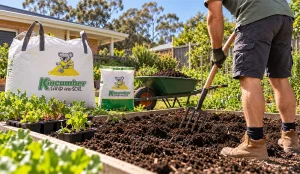
Mulch puts a physical barrier between sunlight and the soil surface. Weed seeds sitting in that top layer never get the light to germinate, and the soil underneath stays cooler and holds its moisture for longer.
Organic mulch also pays you back twice. As it breaks down it feeds soil biology, which improves structure and supports root development. So while the top of the layer is blocking weeds, the bottom of it is slowly turning into better soil.
Which Mulch Suppresses Weeds Best?
Fine, dense mulches beat coarse ones for weed control, because they settle into a tight mat with fewer gaps. So the best mulch for weeds on the Central Coast is usually the one with the smallest particle size you are happy to look at. Across the Kincumber yard’s range, that points to a few in particular:
- Forest Fines, a fine 15mm mulch made from recycled Grade A wood waste, settles quickly into the tight layer weed seeds cannot push through
- Leaf Mulch, chipped tree loppings carrying both hardwood and leaf material, suits native beds where a natural look matters
- Red Hardwood Chip at 20 to 25mm covers large beds and the ground around trees and shrubs efficiently
- Cypress Mulch and Cypress Chip are both termite resistant and long lasting, so they hold their ground where you would rather not top up often
- Sugar Cane and Lucerne, available in bales, break down fast and suit vegetable beds
Pine Bark is the other common choice, in 10mm or 25mm, and it holds its colour well for a forest floor look.
How Deep Should Mulch Go?
Depth decides whether mulch works at all. Landscape guidelines published by Hume City Council specify 75mm to 100mm of organic mulch in garden beds and tree bowls. Too thin and weeds push straight through. Too thick and water struggles to reach the roots you are trying to help.
Two details matter just as much as the number. First, those same guidelines are blunt that thorough weed control must happen before mulching, so clear what is already growing and water the soil first. Second, keep mulch back from trunks and stems, because piling it against them invites rot.
Mulch settles, so expect to top it up every year or two, particularly after heavy rain or strong wind. Do not rake the old layer away. Adding a fresh layer on top keeps both the barrier and the appearance.
Is Organic or Inorganic Mulch Better for Weed Control?
Both block light, but only one improves the soil. Gravel and rubber chips hold their shape indefinitely and never need topping up, which suits paths and dry beds. Organic mulch breaks down, which means replacing it, and also means the soil gets better every season. For most garden beds that trade is worth making.
Which Weeds Are You Actually Fighting on the Central Coast?
Worth knowing before you order. Central Coast Council’s weed control guidance names Bindii as a common local lawn weed through late spring and summer, and treats weed management as a shared responsibility of all landholders.
NSW WeedWise goes further. Its priority weeds list for the Greater Sydney region covers the Central Coast Council area, and it flags the Central Coast as a core infestation area for asparagus fern and Senegal tea plant. Both escaped from gardens, which is worth remembering before anything gets planted near a bushland boundary.
What Else Keeps Weeds Down?
Mulch works harder inside a sensible layout. Plant closely so foliage shades the soil, and use groundcovers in beds where mulch alone leaves gaps. Raised beds, defined borders and proper edging all keep mulch where you put it and weeds where they belong.
Drip irrigation underneath the mulch is the other quiet win. Water goes straight to the root zone instead of evaporating off the surface, which feeds your plants without watering the weed seed above them.
Choosing between types is a separate question, so it is worth reading how to match a mulch to the job if the beds across your place do different things. Landscape soil and the broader garden landscaping products range cover what goes in underneath and around.
How Much Mulch Will Your Beds Need?
Work out the area first, because mulch is sold by volume and 75mm across a big bed adds up quickly. The guide to calculating mulch quantities runs through the arithmetic, and mulch delivery covers the Central Coast in bulk loads. Contact Kincumber Sand & Soil or call (02) 4368 1252 with your measurements. Mulch is the cheapest weeding you will ever do.