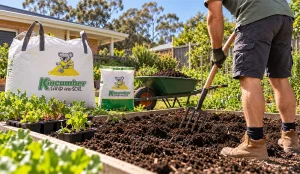

Mixing Sand With Garden Soil is one of the oldest pieces of garden advice going, and one of the easiest to get wrong. Done well it opens up heavy ground and gets water moving. Done badly it sets like concrete and takes a season to undo.
Central Coast blocks make the question harder than most, because the ground changes within a few streets. Clay sits under some suburbs and sandy loam under others. So the honest answer starts with what is already in your garden.
Why Would You Mix Sand Into Garden Soil At All?
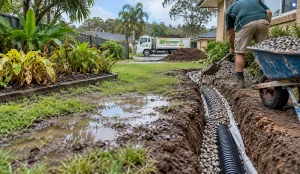
Drainage, mostly. Because clay-heavy ground compacts and holds water, it drowns roots and invites rot. Coarse sand opens the structure so water can move down through the profile instead of sitting in it.
Aeration comes with that. Roots need oxygen, for example, and compacted soil starves them. In addition, looser structure means easier digging, less surface crusting after rain and better seed germination.
None of which makes sand a universal fix. It is a structural change, not a feed, and it only helps soil that has a structural problem.
What Is Your Soil Actually Made Of?
Test it before you buy anything, because the answer decides everything that follows. NSW Agriculture and the Department of Land and Water Conservation published a hand test for exactly this in Assessing the Texture of Your Soil, and it needs nothing but a palmful of soil and some water.
First, wet the soil and knead it into a ball that just stops sticking to your fingers. Then squeeze it between thumb and forefinger into a thin continuous ribbon, let it hang, and measure where it breaks:
- No ribbon at all means sand
- 15mm to 20mm means sandy loam
- About 25mm means loam
- 40mm to 50mm means clay loam
- 85mm to 100mm means medium clay
- More than 100mm means heavy clay
Longer ribbon, more clay. So anything past 50mm is the ground this whole technique is aimed at. However anything under 20mm already drains, and adding sand there makes it worse rather than better.
It is also worth knowing what the maps say. The NSW Department of Climate Change, Energy, the Environment and Water publishes soil landscape mapping for the Gosford area at 1:100,000 scale, viewable through the eSPADE map, so you can see the soil landscape under your own street.
How Should Sand Go Into Clay?
Gradually, and never on its own. NSW Department of Primary Industries and Regional Development puts it simply in its healthy soil guide: dig sand into clay whenever you work it and the improvement comes on gradually, with plenty of organic matter and mulch alongside it.
That phrasing matters. The guide does not name a ratio, and there is a good reason for that. Sand and clay in the wrong proportion behave worse than either on its own, because the fine clay simply fills the gaps between sand grains and the result packs tighter than what you started with. Working it in over several seasons gives you feedback before you commit the whole bed.
Which Sand, and Why Grade Matters
Coarse, washed and screened, in that order of importance. River Sand is the grade for this job, described at the Kincumber yard as coarse, free draining, washed and screened. Fine sand and beach sand do the opposite of what you want, because small particles slot into the gaps and tighten the soil further.
What Goes In With It?
Organic matter, every time. Compost or aged manure is what stops a sand and clay mix going lifeless, because it is the ingredient doing most of the long-term work anyway. So clear the weeds first, break up the surface, then work sand and organic matter through together. Level and water before anything goes in the ground. Finally, checking pH is a sensible last step.
When Is Sand The Wrong Answer?
Mixing Sand With Garden Soil works on heavy ground and backfires on light ground, so three situations rule it out. First, sandy ground does not need more sand, because the problem there is holding water rather than shedding it. Second, loam that already drains gains more from organic matter than from grit. Third, any mix built on sand without compost ends up dry and short of nutrients.
In all three cases a ready-blended soil beats a home experiment. The difference between the two is covered in more detail in topsoil versus garden soil, which is worth a read before ordering either.
Is A Ready-Made Blend Easier?
Usually, yes. Premium Garden Mix at the Kincumber yard is a blend of soil, coarse sand, graded ash, coco peat and composted organics. In other words, it is the same balance a home mix is reaching for, without the trial and error. Top Dress, a screened soil for general landscape work, suits levelling and turf jobs instead.
For bigger areas, top soil delivery runs across the Central Coast in bulk, and the garden landscaping products range covers the edging, mulch and finishing materials that follow.
For wider reading on building healthy soil, the Australian Government’s Your Home guide to soil covers the principles, and The Landscape Association lists accredited landscape professionals across NSW if the job turns out bigger than a weekend.
How Much Will The Job Take?
More than most people expect, because improving soil means working the top 200mm to 300mm rather than dressing the surface. Therefore measure the bed, decide the depth, and the team can turn that into cubic metres and a delivery. Contact Kincumber Sand & Soil or call (02) 4368 1252. Clay rewards patience far more than it rewards a single big load of sand.