
Crushed Rock Landscaping Central Coast searches cover at least four different products. That is why people turn up at a yard and ask for something that does not exist by that name. Crushed rock is a category, not a product.
So this sorts the category out. Which product suits a path, which suits a decorative bed, which belongs under something structural and how each one is sold.
What Do People Mean By Crushed Rock?
Usually one of three things, and they behave very differently.
Quarried crushed gravel, which has angular faces that lock together under foot or wheel. Crushed or decomposed stone fines, which compact into a firm surface. Or round river pebbles, which never lock together because every face is smooth.
In practice that last distinction decides more than appearance. The yard describes its Somersby Pebble, Nepean Pebble and Cowra lines as naturally occurring round river pebbles. So round stone rolls underfoot and migrates out of a path. Angular and crushed material stays where you put it.
Which Product Suits A Path Or Walkway?
Gold Decomposed Granite, which the yard lists specifically as a gold-coloured gravel for pedestrian or vehicular pathways. It sells by the tonne.
Decomposed granite is the usual choice for a walked-on surface because the fines bind as they compact. Limestone at 10mm is the other candidate. The yard describes it as a natural calcium carbonate aggregate from high-purity limestone, sold by the tonne or in 25 to 30kg bags.
Keeping A Gravel Path Where You Put It
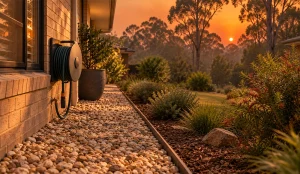
Edge it, then compact it in layers. A path laid loose and left unedged spreads sideways until it is twice as wide and half as deep.
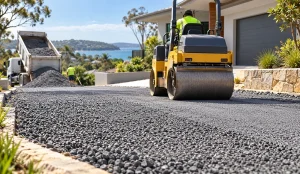
Compacting in thin layers rather than one lift makes the difference, and a light water as you go helps the fines settle. Where the path takes vehicle traffic rather than feet, the Central Coast Council pavement standard drawings give a sense of the base depths involved. The Council notes that those cover typical pavements only, and that each project needs site-specific design.
Which Suits A Decorative Bed Or Ground Cover?
Here appearance leads, because the crushed versus round question reverses. In a bed nobody walks on, round pebbles are fine and often better looking.
Wauchope Pebble is the one worth knowing in this range, a white and gold volcanic rock at 14 to 20mm, which the yard lists as white scoria. Cowra White comes in 14 to 20mm and 40mm, and Cowra Gold in 14 to 20mm. Nepean River pebble runs up to 40mm for a coarser look.
Size does practical work here, not just visual. Larger stone stays put in a sloping bed and shrugs off wind and runoff. Smaller grades, however, sit tighter and look more finished on a flat area.
Which Suits A Base Under Something?
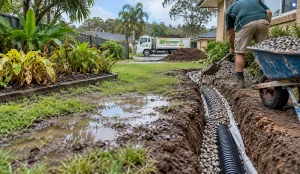
A different product entirely. The choice there depends on whether you want the material to compact or to drain, which is its own question. What road base is and where it goes sets that out in full.
In short: compacting material from the aggregate range under a surface, clean single-size gravel around drainage. Do not substitute one for the other.
Does A Gravel Surface Need Council Approval?
Sometimes, however the answer turns on drainage rather than on the stone. The NSW Planning Portal guidance on driveways, pathways and paving treats these as exempt development only where the conditions are met. Run-off must go to a drainage system connected to the existing stormwater system. Foreshore areas, environmentally sensitive land and heritage items are all carved out.
Central Coast Council is more direct about the consequence. The Central Coast Council stormwater on private property guidance states that hardstand areas must control stormwater so it does not flow onto adjacent property. It also recommends minimising water-resistant surfaces.
A compacted gravel surface sheds a lot more water than bare ground, so work out where that water goes before the load arrives. The NSW EPA stormwater guidance covers what may and may not enter the system.
How Much Will You Need, And How Is It Sold?
Crushed rock landscaping Central Coast loads mostly sell by the tonne, which catches people used to buying soil and mulch by the cubic metre. Decomposed granite, Limestone and the pebble lines all sell that way. Several also come in 25 to 30kg bags for a small job.
Work from area and depth, then ask at the counter rather than converting it yourself. Tonnes to cubic metres is not a fixed conversion, because it changes with the stone.
Not Sure Which One You Need?
Say what the area is for, and whether anything will walk or drive on it. Then the team will name the product rather than the category. Bulk landscape supplies cover whatever else the job needs. If the job is a driveway rather than a path, the gravel driveway guide is the better starting point.
Contact Kincumber Sand & Soil or call (02) 4368 1252. Open Monday to Friday 6:30am to 4pm and Saturday 6:30am to 12pm.