
Erosion and sediment control on the Central Coast is not optional paperwork. Council treats it as part of building work, and sediment that leaves a site can count as pollution even if it never reaches a creek. Whatever the trade, the job stays the same: keep the soil on the block until the site is stable again.
The materials are simple, and the yard’s building supplies range carries the basics:
- Silt Control Fence
- Silt Control Bags
- Geotextile (Trench Fabric)
- Plastic sheeting in 2 or 4 metre widths
What follows covers where each one goes and what the rules ask for.
Is Erosion And Sediment Control Compulsory On Every Job?
Yes. Central Coast Council’s erosion and sediment control page states that controls are mandatory for all building works. They often form a condition of consent as well. The page also says to use them wherever an activity disturbs soil or removes vegetation, so plenty of landscaping jobs fall within scope.
The penalties sit under state law. Council notes that causing pollution is an offence under the Protection of the Environment Operations Act 1997. Council officers or the EPA may issue fines, and serious cases can go to court.
What The NSW Sediment Control Guidelines Require
A plan, controls in place before work starts and maintenance until the site is stable. For erosion and sediment control on the Central Coast, the state guidelines fill in the detail. The NSW Planning Portal’s guidelines page explains that the 2024 edition covers sites of roughly 250 to 2,500 square metres. It applies as a requirement where a development consent calls for it, and the Landcom “Blue Book” carries the detailed engineering.
The NSW Government’s Guidelines for erosion and sediment control on building sites set out three ground rules:
- Install erosion and sediment controls before starting work
- Keep them working from the start of construction until landscaping finishes and the ground is stable
- Everyone involved in construction shares responsibility for keeping sediment and dirty water on site
Installing A Sediment Fence
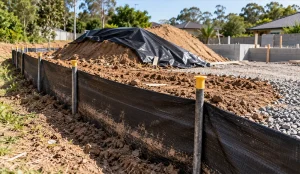
Run it along the low side of the site, following the contour, with the fabric buried. The same guidelines describe a geotextile fabric held up by posts and a backfilled trench, and give these details:
- Dig a 150mm trench on the upslope side of the fence
- Drive star pickets, usually 2.5 metres apart
- Run the fence parallel to the contours wherever possible
- Add a small return about every 20 metres, so no single section takes all the water
How Long Does A Sediment Fence Last?
Up to six months, according to the guidelines, but only with checking. They call for a designated person to check controls daily and after rainy or windy weather, removing any built-up sediment. Autumn is the local test, since March carries the highest median rainfall on the Bureau of Meteorology’s Gosford record at 150.4mm.
Where Can A Stockpile Sit On A Building Site?
Inside the site and behind the sediment controls, clear of anywhere water concentrates. Where possible, the guidelines put stockpiles 5 metres from concentrated run-off, drains, driveways and sensitive areas. Two metres is the minimum. They also rule out storing stockpiles and building materials on the footpath or in the road reserve.
Cover the pile when nobody is on site, or whenever rain or wind is coming. That matters when ordering a bulk drop of sand or soil, because the load needs a spot that meets those distances. Pick up or delivery covers what a tipper needs to reach that spot.
Stabilising The Site Entry
One stabilised entry and exit point, at least 3 metres long. The guidelines say that length gives sediment time to shake off the tyres. They allow gravel, aggregate or recycled concrete on the surface without naming a grade. The yard’s aggregate range is the place to start.
Setting it up comes first, too. Council hosts the NSW Government’s model plan for single residential allotments, and it lists the stabilised entry as step one, ahead of the sediment fence.
Protecting The Kerb Inlet From Sediment
Slow the water before it reaches the drain. The guidelines describe two options. Sandbags upslope of the drain collect sediment. Alternatively, a gravel filter roll of wire mesh and geotextile, filled with gravel, sits in front of the kerb inlet. Because those inlets sit on the road, the guidelines also advise checking with Council first. Central Coast Council’s main line is (02) 4306 7900.
Handling Concrete Spills On Site
Catch them, then sweep them up. The guidelines suggest a plastic sheet under the concrete pump to catch spillage. They also say to sweep up any spill before removing bunds, rather than washing it away. Filtering or flocculant systems for concrete washdown need Council approval.
Stocking Up On Sediment Control For The Next Job?
List the fence length, the number of inlets and the stockpiles you expect. The team can then put the fence, bags, fabric and plastic together in one order. Contact Kincumber Sand & Soil or call (02) 4368 1252.