
Road Base Central Coast searches usually come from someone about to lay a driveway, a slab or a run of pavers. In all three cases the material underneath matters more than the surface on top. Get the base wrong and the surface moves. Get it right and it stops being something you think about.
The confusing part is that several aggregates look similar in a trailer. However they behave nothing alike once compacted. So here is what road base actually is, what it is not and which grade belongs in which job.
What Is Road Base, and What Is It Not?
Road base is a quarried mix of gravels in a range of particle sizes. The smaller fragments fill the gaps between the larger ones, so the whole layer locks together under compaction. That interlock is the entire point. Clean single-size gravel cannot do it, because nothing fills the voids.
The Kincumber yard lists the product as Metal Slab Fill (Road Base): a quarried mix of gravels of varying sizes designed to compact. It goes under concrete slabs, under pavers and under gravel driveways.
Road Base Is Not Crusher Dust
Worth being clear on, because people use the two terms interchangeably. They are not the same thing. ¼ Minus (Crusher Dust) which Kincumber Sand & Soil also supply, is a separate product of metal dust fines, and the yard lists it as a compactable underlay for pavers. It runs much finer than road base.
In practice crusher dust gives you a smooth levelling layer over a base. Road base gives you the structural layer itself. Asking for one and getting the other wastes a trip, so use the product names rather than the generic terms.
Which Aggregate Does Which Job?
Five products cover almost everything. Sorting them is simple, because the question is only ever whether you want the material to compact or to drain. Those two jobs pull in opposite directions.
Compacting Under A Surface
Road base for the structural layer, as above. Then crusher dust over the top of it where pavers need a fine levelling bed.
Drainage Around Pipe And Behind Walls
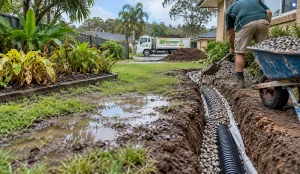
Clean, single-size gravel, because the voids are what let water move. Plumbers Mix 7-10mm, a quarried crushed gravel, suits concrete mixes and doubles as a drainage aggregate over plumbing pipes. Drainage Mix 14-20mm is the coarser option, including behind retaining walls over agricultural pipe.
Drainage Ash is the other one worth knowing. A lightweight 40mm material, the yard lists it as ideal backfill behind retaining walls. Weight matters there, since every tonne behind a wall is load the wall has to carry.
Where that water ends up is a legal question as well as a practical one. NSW EPA guidance on stormwater covers what you may and may not send into the system. Read it before a trench gets dug toward a boundary.
Concrete Mixes
Plumbers Mix again. One product therefore covers both the pour and the drainage work on most residential jobs.
How Deep Should A Compacted Base Go?
Deeper than most people expect, and in layers rather than one lift. Central Coast Council publishes its own pavement standard drawings, and the figures give a useful sense of scale. A base course runs 120mm to 200mm of approved base course material. Under that sits a sub-base of 200mm to 250mm. The subgrade compacts to 95 per cent standard.
Two caveats, both from the Council’s own notes. Those drawings cover road pavements rather than residential driveways. The Council also states they are typical pavements only, and that each project needs site-specific geotechnical testing and pavement design. So treat them as a reference point rather than a specification for your own block.
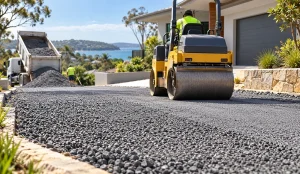
The practical takeaway holds regardless. Compact in layers, not in one go, and water each layer lightly as you compact it. A 300mm base laid in one lift compacts on top and stays loose underneath. That is exactly how a driveway develops ruts in its first wet season.
Does A New Driveway Need Council Approval?
Often yes, and this one catches people after the materials have arrived. Central Coast Council requires approval for a vehicle access crossing. Its guidance is explicit: you must get Council approval to build a new crossing or alter an existing one. Development consent on its own is not enough.
Council usually processes a straightforward application within 14 to 21 days, and up to 28 for a more complex design. A new crossing also has to comply with Australian Standards and Council policies. Beyond that it must stay safe for vehicles and pedestrians, avoid conflicting with existing or future infrastructure and adequately manage stormwater.
Second crossings generally get refused. The exceptions are a frontage past 20 metres, a corner block or a documented safety reason. Check before ordering, because three weeks of lead time is easier to absorb than a pile of road base sitting in the way.
How Much Will You Need?
Work from area and compacted depth, then add a margin, because compaction reduces the volume you laid. For the surface decisions that sit on top of the base, the gravel driveway guide covers those. If pavers are going down instead, which sand goes under pavers deals with the levelling layer.
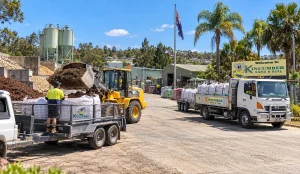
Loading is straightforward either way. Road base Central Coast deliveries run on the yard’s own tipper trucks, and because the yard at 4 Kerta Rd, Kincumber is a drive-through, a trailer never needs reversing either. The full aggregate range sits alongside building supplies and the wider Kincumber landscape supplies range.
Ready To Work Out A Load?
Bring the measurements and what is going on top. Then the team will tell you which grade and how many tonnes. Contact Kincumber Sand & Soil or call (02) 4368 1252. Open Monday to Friday 6:30am to 4pm and Saturday 6:30am to 12pm.