
The Benefits Of Decorative Pebbles Central Coast gardeners talk about usually come down to one thing: not doing the job again next year. Bark breaks down and needs topping up. Stone does not.
That is the real comparison, and it is worth making properly before a trailer gets loaded. So this covers what pebbles actually do in a bed, where mulch still beats them, and which products in the decorative pebbles range suit which job.
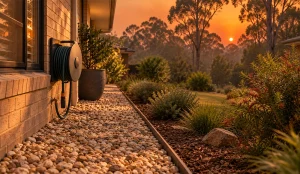
What Decorative Pebbles Actually Do In A Garden
Four things, and only two of them are about looks:
- Hold their place. Stone does not decompose, so a bed laid once stays at the depth it was laid at.
- Suppress weeds, as long as a weed mat goes underneath. The stone blocks light and the mat stops anything pushing up through it.
- Drain freely, because water runs between the stones rather than sitting in a layer that holds moisture.
- Stay put in wind, which matters on exposed blocks where a light bark mulch ends up on the driveway.
The last one is worth a figure. Bureau of Meteorology climate averages for Gosford put the annual mean rainfall at 1,325.3mm, with March the wettest month at 214.9mm. A bed that takes that much water in a short stretch needs a surface that neither washes away nor turns to sludge.
Pebbles Or Mulch? The Honest Comparison
Both have a place, and the yard sells both, so here is the straight answer rather than a sales one.
Where Pebbles Win
Permanence, drainage and wind resistance. A pebble bed costs more to lay and then costs almost nothing, while a bark bed costs less to lay and then costs again every year or two.
Pebbles also win anywhere mulch would wash or blow: a slope, an exposed corner, a narrow strip beside a driveway, or around a pool where bark tracks indoors on wet feet.
Where Mulch Still Wins
Anything you are trying to grow well. Mulch breaks down into the soil, and that is the whole point of it. Stone contributes nothing to soil structure, so a productive bed or a new planting is usually better off under bark.
Council takes the same view for its own planting. Its landscaping standard drawings specify 100mm of mulch for verge trees and tubestock planting, not stone. So for anything establishing, the mulch range is the sensible starting point.
What The Mulch Rules Actually Cover
Worth knowing, because mulch is a regulated product and stone is not. The NSW EPA mulch order defines mulch as plant material shredded or screened to a set particle size, and it sets out what must not be in it: asbestos, engineered wood products, preservative treated or coated wood residues, glass, metal, plastics or polystyrene.
Kerbside collection material is excluded from that order as well. None of this applies to stone, which is simply quarried and graded, and that difference is part of why a pebble bed carries no surprises.
Which Pebbles The Yard Actually Stocks
Nine products, and the names matter when ordering because the generic terms get confused:
- Somersby Pebble, a 10-15mm river pebble in red, white and brown. Supplied unwashed, so expect to hose it once it is spread.
- Nepean River 20mm and 40mm, natural river stone in blue, green and grey shades.
- Cowra White, in 20mm and 40mm, white with grey flecks.
- Cowra Gold, a 20mm gold river pebble.
- Wauchope Pebble, a 14-20mm white and gold volcanic rock, sold as white scoria.
- Lucky Stone at 75-150mm, natural river stone for feature work rather than ground cover.
- Limestone 10mm, a calcium carbonate aggregate.
- Gold Decomposed Granite, the one product in the range listed for vehicular pathways as well as pedestrian ones, so it is the pick for a driveway or a path that takes a car.
Choosing between the colours and sizes is a longer conversation, and which decorative pebbles work best for Central Coast gardens goes through it properly.
Where Pebbles Are The Wrong Answer
Three cases, and it saves money to know them before ordering.
A bed you plan to dig regularly. Stone and soil mix once a spade goes through, and separating them afterwards is miserable work.
A vegetable garden or anything else being actively grown, for the soil reasons above.
A bed with no edging. Without a firm border, stone migrates into lawn, finds the mower and stays there. Edging goes in first, not last.
Ready To Price A Load?
Bring the length and width of the bed and a note on how deep you want the layer. Then the team can work out the tonnage, since weight per cubic metre differs between a 10-15mm river pebble and a 75-150mm feature stone.
Most products come by the tonne or in 25 to 30kg bags, and the yard at 4 Kerta Rd, Kincumber is a drive-through, so a trailer loads without reversing. Get in touch with Kincumber Sand & Soil or call (02) 4368 1252. Open Monday to Friday 6:30am to 4pm and Saturday 6:30am to 12pm.