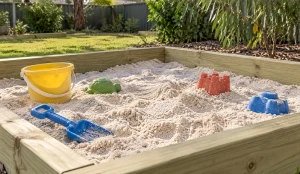

Soil For Raised Garden Beds Central Coast questions almost always arrive at the same moment. The beds are up, and now they need filling. What goes in decides how the bed performs for years. A raised bed has no subsoil underneath to fall back on, so whatever you put in is the whole root zone.
So this covers four things. What to fill a new bed with, how deep it needs to be, which products suit which plants and the one thing you should never do to topsoil.
Why Does A Raised Bed Need Different Soil?
Because nothing else is holding the plants up. A garden planted in the ground draws on whatever sits below it. In addition, moisture moves up from deeper layers. A raised bed has a defined bottom, so it has to do four jobs at once: hold moisture, drain freely, stay open enough for air and carry nutrients.
That rules out straight topsoil on its own. Screened soil makes a fine base, and the yard sells it by the tonne as Top Dress. In a raised bed on its own, however, it compacts and holds water.
What Should The Mix Actually Contain?
A blended garden soil rather than a single ingredient. Premium Garden Mix is the yard’s blend for this. The yard lists it as soil, coarse sand, graded ash, coco peat and composted organics.
Each part also does a job of its own. The sand and ash keep it draining, the coco peat holds moisture and the composted organics feed it.
Compost on top of that is worth adding. Here it pays to know what you are buying. The Australian Government’s review of recycled organics standards calls AS 4454 the benchmark standard for compost quality in Australia. It sets limits on contaminants and sorts products by maturity and particle size. Because it is voluntary, though, ask rather than assume.
Growing Natives In A Raised Bed?
Then go easy on the compost and fertiliser. NSW DPIRD’s healthy soil guide states that native plants are very sensitive to phosphorus. That rules out most general garden fertilisers. For that reason the yard bags Native Mix in 30 litres.
How Deep Should The Bed Be?
Deeper than it looks like it needs to be. NSW EPA guidance on gardening where soil may contain lead sets out three things for a raised bed. Build it at least 30cm tall, higher for large plants. Line the base with mesh to allow drainage and prevent soil mixing. Fill it with certified clean soil from a nursery.
That advice lands harder on the Central Coast than it might sound. The EPA names lead paint around the home as a reason to stay vigilant. Plenty of older weatherboard and fibro houses here carry paint from well before the phase-out. A raised bed with a mesh base and clean imported soil sidesteps the question entirely.
For depth generally, Central Coast Council’s own landscaping standard drawings give a benchmark. That specification puts topsoil depth for mass plantings at 200mm to 300mm. Shallow herbs cope with less. In practice, anything with a real root system wants that range.
What Should You Avoid?
Three things, and one of them catches almost everyone.
Never Compact The Soil
This is the big one. The same Council specification rules out compacting topsoil by any means beyond light firming. As a result, treading a bed down to settle it undoes the air space roots need. Water it in instead, then top it up once it has dropped.
That specification also says not to mix subsoil and topsoil together. The same logic holds in a raised bed. So resist the urge to turn the native ground into the mix below.
Fresh Manure And Unscreened Fill
Fresh manure burns young roots, so use aged product only. The yard bags both Mushroom Compost and Cow & Compost, and both have already broken down.
Unscreened fill is the other one to avoid. It also brings weed seed and rubble in with it, and that becomes a problem you own for several seasons.
Which Products And How Much?
Work out the volume first. Length by width by depth, all in metres, gives cubic metres. For example, a bed 3 metres by 1 metre filled to 300mm needs close to one cubic metre. Bagged product suits one small bed, while anything past that costs less by the cubic metre.
Still weighing up soil types? The difference between topsoil and garden soil sets out which one does which job. Soil for raised garden beds on the Central Coast is only part of the picture, though. Bulk loads of any of it deliver across the Central Coast on the yard’s own tippers. Building the bed walls as well? The yard carries treated pine in sleeper sizes.
Not Sure How Much Your Beds Will Take?
Bring the dimensions of each bed and what you plan to grow. Then the team at 4 Kerta Rd, Kincumber will work out the volume and say which mix suits those plants. Get in touch with Kincumber Sand & Soil or call (02) 4368 1252.