
Best Time To Lay Turf Central Coast comes down to two things the local climate decides for you: soil warmth and rainfall.Get both in your favour and the turf knits down in a fortnight over a properly prepared soil bed. Get them wrong and you spend a season nursing it.
So this works through three things. The window that suits here, what goes under the turf before it arrives and how much watering the Council rules allow.
When Is The Best Time To Lay Turf On The Central Coast?
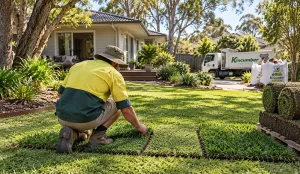
Spring, with early autumn running a close second. Turf needs warm soil to root and steady moisture while it does, and those two line up best either side of summer. That holds whichever of the turf varieties that suit this area you end up laying.
Why Spring Comes Out Ahead
The local numbers make the case. The Bureau of Meteorology climate averages for Gosford AWS show mean monthly maxima rising through spring. September sits at 22.2 degrees, October at 24.3 and November at 25.2.
September is also the driest month on that record at 63.0mm, against an annual average of 1,325.3mm. That sounds like a drawback. In practice it is an advantage, because you control the water yourself rather than having a downpour wash out a freshly laid lawn.
Is Autumn Any Good?
Yes, as long as March has passed. The same station records March as the wettest month of the year at 214.9mm, with April second at 153.0mm.
Laying turf into that is asking for trouble. Soil worked wet turns to mud, the rolls sink unevenly and heavy rain lifts the joins. April into May works far better, with warmth still in the ground.
Can You Lay Turf In Summer Or Winter?
Both are possible and both cost you more work. Summer is the harder of the two. January and February average 28.0 and 27.3 degrees, so a new lawn dries out within hours of watering.
Winter is the slower one. June and July sit at 18.0 and 18.2 degrees on that record. Mild by national standards, however, is still too cool for quick root growth. Turf laid in July sits there looking unchanged for weeks, which is normal rather than a failure.
What Goes Under New Turf?
Prepared soil, and more of it than most people allow for. Turf laid straight onto scraped subsoil roots into nothing, which is why the landscape soil range matters more here than the turf does.
The Central Coast Council landscaping standard drawings set out the method for the Council’s own turf work. Cultivate the subgrade to a nominal 100mm. Ameliorated topsoil goes over that at 150mm deep. Then mix fertiliser evenly through the topsoil before the turf goes on, rather than scattering it after.
That specification also rules out compacting topsoil by any means beyond light firming. Rolling a bed hard before laying turf feels thorough and does real damage.
How Deep, And How Firm?
Work to that 150mm as a guide and firm it by hand or with a light roller, no more. Then check what is underneath before you decide how much to bring in.
The NSW Government guide to assessing the texture of your soil gives a ribbon test you can do in the yard. A ribbon of 5mm means sand and a ribbon past 50mm means clay. Clay under a new lawn needs more underlay than sand does, because the roots will not get far into it.
How Much Watering Will It Need?
Daily at first, and the local rules make room for exactly that. Under the Central Coast Council Level 1 water restrictions, sprinklers and watering systems may establish a new lawn or garden for 14 days from installation. After that they may only run before 10am and after 4pm.
Bore water and recycled water fall outside the restrictions. Levels move with dam storage, so confirm which one applies before booking a delivery around a watering plan.
That 14 day allowance lines up neatly with how long new turf takes to knit down. So timing the job matters as much as the turf itself.
Where Does The Turf Itself Come From?
A turf farm or a turf supplier, not from the Kincumber yard. Worth saying plainly, because the yard supplies everything that goes under and over the turf rather than the rolls themselves.
That means the soil bed first, and the bulk soil delivery range, where Top Dress sells by the tonne. Then, once the lawn has taken, Nitro Top keeps it level. When and how often to dress a lawn covers that side of it.
Bring the area of the lawn and a rough idea of the ground underneath. Then the team will work out how much underlay it needs and when to have it on site. Contact Kincumber Sand & Soil or call (02) 4368 1252.