How Deep Should Mulch Be Central Coast gardeners ask this after the first batch disappoints. Weeds came through. The soil dried out anyway, and the bed looked thin within a month.
Depth is almost always the reason. So here is the figure Council works to, why too much is as bad as too little, and how often a bed needs topping up.
The Short Answer Is 100mm
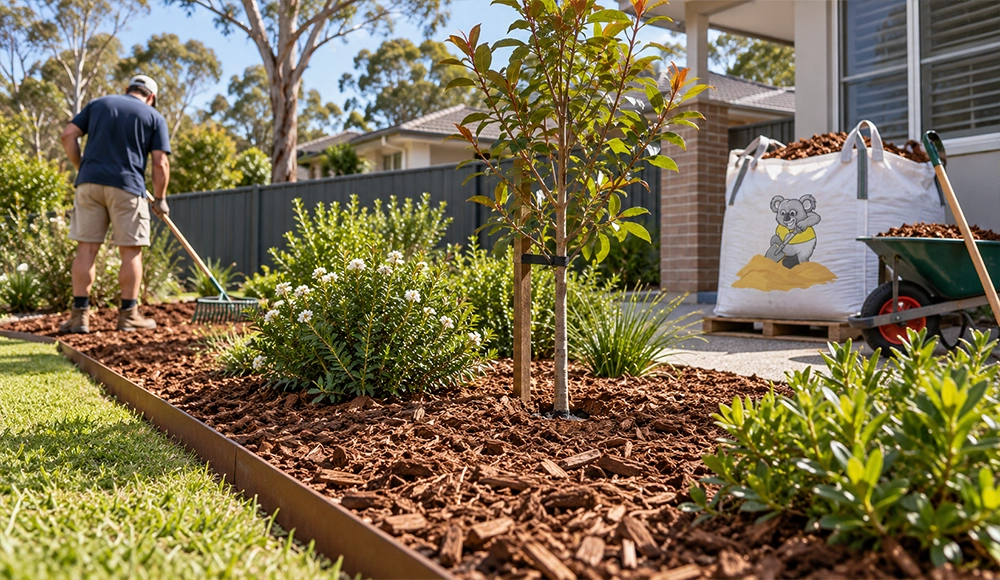
That is the figure Central Coast Council specifies for its own planting. Its landscaping standard drawings call for 100mm deep mulch across five separate details: street trees in the verge, road blisters, mass planting in parks and reserves, tubestock planting and bioretention basins.
Five drawings landing on the same number is worth noting. It is the depth Council has settled on for work it has to maintain at scale, which makes it a sound benchmark for a home bed. Everything in the mulch range sells by the cubic metre, so 100mm across a measured bed converts straight into an order.
Why Depth Decides Whether Mulch Works
Mulch does three jobs: it blocks light so weed seed cannot germinate, it slows evaporation from the soil surface, and it breaks down into the soil over time. Depth governs the first two directly.
Too Thin Does Nothing
Below about 50mm, light still reaches the soil. Weed seed germinates, the surface dries between waterings, and the bed needs topping up almost straight away.
A 25mm scatter looks tidy for a month. Then it is gone, and the cost of doing it twice beats the cost of doing it properly once.
Too Thick Causes Its Own Problems
Past roughly 150mm, mulch starts working against the garden. Water struggles to reach the soil through a deep dry layer, and planting through it becomes awkward.
Deep mulch piled against a stem is worse again, which is the next point.
Keep It Clear Of Stems And Trunks
Council is explicit about this in the same drawings: mulch is kept clear of stems and trunks. Piling it against a trunk holds moisture against the bark, and that is where collar rot starts.
So rake a small clear circle around each plant rather than mounding mulch up to it. The depth figure applies across the bed, not against the plant.
Does The Mulch Type Change The Depth?
Somewhat, and it comes down to particle size. A coarse, chunky mulch holds its depth and lets water through easily, so 100mm works well and lasts.
A fine mulch packs tighter. It suppresses weeds at a slightly shallower depth but it can also form a crust that sheds water, so it wants checking after heavy rain. The mulch range covers both ends, and choosing the right mulch goes through which suits which bed.
Where a bed sits exposed, stone is the alternative that will not blow away. Decorative pebbles sit at a different depth again, and the pebbles guide covers that.
How Often Does Mulch Need Topping Up?
Organic mulch breaks down, which is the point of it, so it needs replenishing rather than replacing. How fast depends on the particle size and the weather.
The Australian Government’s review of recycled organics standards names AS 4454 as the benchmark standard for compost and mulch quality in Australia, and that standard sorts products by maturity and particle size. Those two factors are what govern how long a mulch lasts, so a coarse mature product holds up longer than a fine green one.
Local rainfall drives it too. Bureau of Meteorology climate averages for Gosford name March the wettest month at 214.9mm against September at 63.0mm, with an annual mean of 1,325.3mm. That much water through a bed breaks mulch down faster than a drier inland garden would.
Checking depth once a year is the practical answer. Top up to 100mm rather than starting again.
What Should Be In The Mulch You Buy
Worth knowing, because mulch is a regulated product in NSW and a lot of what gets sold loosely is not. The NSW EPA mulch order defines mulch as plant material shredded or screened to a set particle size.
It also sets out what must not be in it. Asbestos, engineered wood products, preservative treated or coated wood residues, glass, metal, rigid or flexible plastics and polystyrene are all excluded, and so is kerbside collection plant material. Mulch carrying weeds, diseases or pests must not be supplied for land application in an environmentally sensitive area.
So ask where a cheap load came from. A screened product from a yard is a different thing to a trailer of chipped unknowns.
Working Out How Much You Need
Length by width by depth, all in metres. A bed 5 metres by 2 metres at 100mm works out at 5 × 2 × 0.1, which is 1 cubic metre.
Mulch settles, so add roughly 10 per cent. How much mulch do I need works through larger beds, and ordering bulk landscape supplies covers the load sizes and the drop.
One more reason to get the depth right: mulch at the proper depth cuts watering. Central Coast Council’s Water Wise Rules permit watering only before 10am and after 4pm, so holding moisture in the soil matters more here than it would somewhere with no restrictions at all.
Ready To Measure Up A Bed?
Bring the length and width of each bed and say what is planted in it. Then the team can work out the volume and recommend a grade that will hold its depth.
The yard at 4 Kerta Rd, Kincumber is a drive-through, so a trailer loads without reversing, and larger loads deliver across the Central Coast on the yard’s own tippers. Get in touch with Kincumber Sand & Soil or call (02) 4368 1252. Open Monday to Friday 6:30am to 4pm and Saturday 6:30am to 12pm.