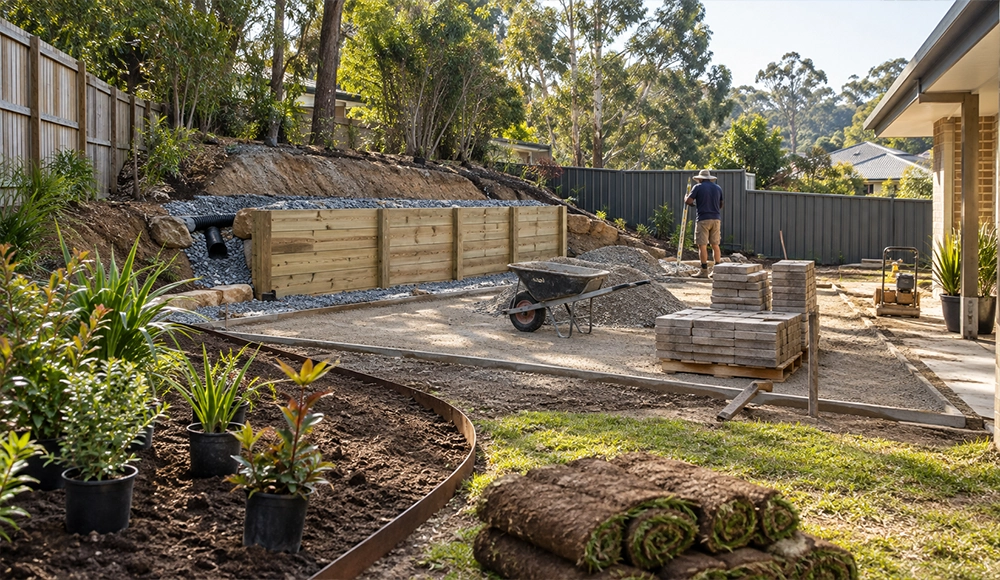
Backyard Project Order Of Works Central Coast jobs go wrong in a predictable way. The soil arrives before the treated pine does, so six cubic metres sit exactly where the retaining wall needs to go.
Nobody plans that. It happens because somebody orders materials in the sequence they thought of them, rather than the sequence the job needs. So here is the order that works, and when each load should land.
Why The Order Matters More Than The Budget
Because moving material twice costs more than buying it once. Every load that lands in the wrong spot moves again by hand. That is the most expensive labour on any site.
Sequence also decides what is still possible. Once pavers are down, getting a bobcat to the back fence is over. Once turf goes down, a trailer cannot cross it. Each stage closes off access to the one behind it, so the order runs from the back of the block forward and from the ground up.
The Order Of Works, Start To Finish
Seven stages. Trade will know most of this, and it is the stage boundaries that matter rather than the detail inside them.
1. Approvals, Before You Order Anything
Some of this work needs consent and some does not, and the conditions are more specific than people expect. The NSW Planning Portal guidance on earthworks, retaining walls and structural support sets out what State policy requires for the work to be exempt.
Five conditions apply, and the work must meet all five:
- Not on or in a heritage item or a draft heritage item, and in a heritage conservation area it goes in the rear yard.
- At least 40 metres from a body of natural water.
- No redirecting of surface or ground water.
- No sediment sent onto an adjoining property.
- At least 2 metres horizontally from any other retaining wall on the site.
A new driveway is separate again. Central Coast Council’s vehicle access crossing requirements say you need Council approval to build a new crossing or alter an existing one, separately from any development consent. Straightforward applications run 14 to 21 days, and complex designs up to 28. That lead time sets the start date for everything else.
2. Clear And Demolish
Old concrete, dead shrubs, the rotting sleeper wall and the half-buried clothesline footing. All of it comes out before anyone sets a level, because every one of them changes what the ground does.
This is also the stage to find services. Mark anything buried before a machine arrives rather than after.
3. Set The Levels And The Drainage
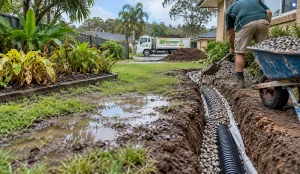
The least visible stage and the one that decides whether the job lasts. Falls happen here, and drainage goes in while the ground is still open.
Getting this wrong is expensive, because fixing a fall after paving means lifting the paving.
Where The Water Can Legally Go
Worth checking before anyone digs a trench toward a boundary. Central Coast Council’s guidance on stormwater on private property names three legitimate destinations: the Council street kerb and gutter, an inter-allotment drainage system, or a Council-controlled drainage easement or reserve.
Two rules come with it. An owner must not divert, redirect or concentrate the flow from its natural path onto neighbouring properties. A downstream owner must accept natural overland flow and cannot block it with a large wall or closed fencing.
4. Retaining And Structures
Walls, steps, raised beds and anything else holding ground. These go in before surfaces, because they define the levels that surfaces sit against.
Treated pine sleepers are the usual choice, and the hazard class matters here. Ask for H5 rather than H4 for a retaining wall, and expect a wait while it comes in. Drainage gravel goes in behind the wall as it goes up, not afterwards.
5. Hard Surfaces
Driveways, paths, patios and anything taking vehicles. The base is the part that decides the lifespan, and the road base guide covers compaction in layers and why a thick lift laid in one go stays loose underneath.
Metal Slab Fill (Road Base) is the structural layer, and ¼ Minus (Crusher Dust) is the compactable underlay the yard lists for pavers. Which sand goes under pavers covers the bedding layer properly. Order these before the soil, because a trailer of road base can still cross bare ground.
6. Soil And Beds
Now the soft landscaping starts. Beds build up, edging goes in and soil arrives.
Depth is worth getting right. Central Coast Council’s landscaping standard drawings put topsoil for mass plantings at 200mm to 300mm. They also rule out compacting topsoil by any means beyond light firming. The organic top dress soil range covers the blends, and steel edging is what holds them in place.
7. Turf, Planting And Mulch Last
Last for a reason. The traffic from every earlier stage damages anything living.
Council’s turfing detail is specific and it transfers to a backyard. Cultivate the subgrade to a nominal 100mm deep at 600mm centres, running parallel to the contours. Mix fertiliser evenly through the topsoil before the turf goes down rather than after. Then lay the turf within 36 hours of cutting. Turf varieties covers which grass suits which block, though the turf itself comes from a turf supplier rather than this yard.
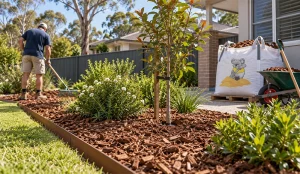
Then mulch goes on, at 100mm per the same Council specification. The mulch range covers the grades.
When To Order Each Load
Order against the stage, not the whole job. Bulk material sitting on a site for three weeks takes the rain, the foot traffic and the wind.
A rough rule that holds for most residential jobs:
- Road base and aggregate land at the start of stage 5, once structures are standing.
- Sand lands with the pavers, not before.
- Soil lands at stage 6, once the hard surfaces have finished curing.
- Mulch lands after planting, as the last delivery on site.
Three Ways Deliveries Go Wrong
Access is the first. A tipper needs headroom and a clear run, and a low branch or a parked car turns a delivery into a return trip.
The drop point is the second. Decide it before the truck arrives, and make it as close to the work as the truck can safely get. Every metre saved is a wheelbarrow trip you do not make.
Timing against the weather is the third. A soil delivery the day before 50mm of rain gives you a tonne of mud, and local rainfall is not evenly spread. Bureau of Meteorology climate averages for Gosford name March the wettest month at 214.9mm against September at 63.0mm.
Planning A Job? Bring The Sequence
Bring a rough plan and the stages you have in mind. Then the team can tell you what to order when, and roughly how much of each.
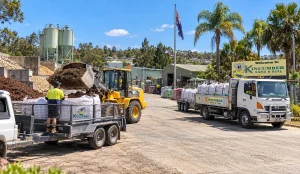
The yard at 4 Kerta Rd, Kincumber is a drive-through, so a trailer loads without reversing, and larger loads deliver across the Central Coast on the yard’s own tippers. Get in touch with Kincumber Sand & Soil or call (02) 4368 1252. Open Monday to Friday 6:30am to 4pm and Saturday 6:30am to 12pm.