Low Maintenance Garden Ideas Central Coast homeowners actually use tend to be unglamorous. Less lawn, deeper mulch, a hard edge between the two, and soil sorted properly the first time.
That is the whole trick. A low-maintenance garden is not a different style of garden. It is one where somebody designed out the jobs that repeat. So here is what repeats, and what removes it.
What Actually Makes A Garden Low Maintenance?
Fewer recurring jobs, not fewer plants. Mowing, edging, weeding, watering and topping up mulch are the five that come back. Each one shrinks at the design stage rather than needing management forever.
Low maintenance does not mean no maintenance either. A pebble bed still needs leaves blown off it, and a mulched bed still needs topping up eventually. The aim is to cut the frequency, not pretend it reaches zero.
Replace Lawn Where It Is Not Earning Its Keep
Lawn eats more time than anything else in most backyards. Plenty of it survives out of habit rather than use. The strip beside the driveway, the shaded corner under a tree, the awkward wedge behind the shed. Nobody walks on any of them.
Where Pebbles Beat Lawn
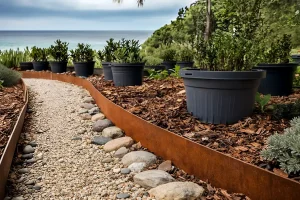
Anywhere narrow, shaded or sloped. Stone does not grow, so it never needs mowing. It does not decompose either, so it holds the depth you spread it at.
The decorative pebbles range covers the options. Then the benefits of decorative pebbles sets out where stone beats bark. A weed mat underneath is not optional with either.
Where Mulch Beats Lawn
Any bed you are actually trying to grow something in. Mulch holds moisture, suppresses weeds and feeds the soil as it breaks down, which stone cannot do.
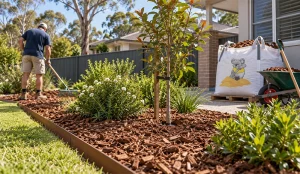
Depth is what decides whether it works. Central Coast Council’s landscaping standard drawings specify 100mm of mulch for verge tree and tubestock planting. That is a sensible benchmark for a home bed too. A thin 25mm scatter looks tidy for a month and then grows weeds. The mulch range covers the grades.
Get The Soil Right Once
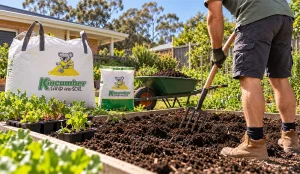
Most ongoing garden work is really soil work in disguise. Plants that struggle need feeding, watering and replacing, and plants in decent soil largely look after themselves.
That same Council specification puts topsoil depth for mass plantings at 200mm to 300mm. It is blunt about handling, too: under no circumstances is topsoil to be compacted by any means beyond light firming. So resist treading a new bed flat. Water it in and top it up once it has settled instead.
The NSW DPIRD guide to garden soils covers how texture governs all of this. That matters locally, because clay sits in heavy bands across much of the region. The organic top dress soil range is where the blends for that sit.
Edge Everything, Properly
This is the highest-value hour in the whole project. Without a hard edge, lawn creeps into beds and mulch washes onto paths. Stone migrates into the lawn as well, where it finds the mower.
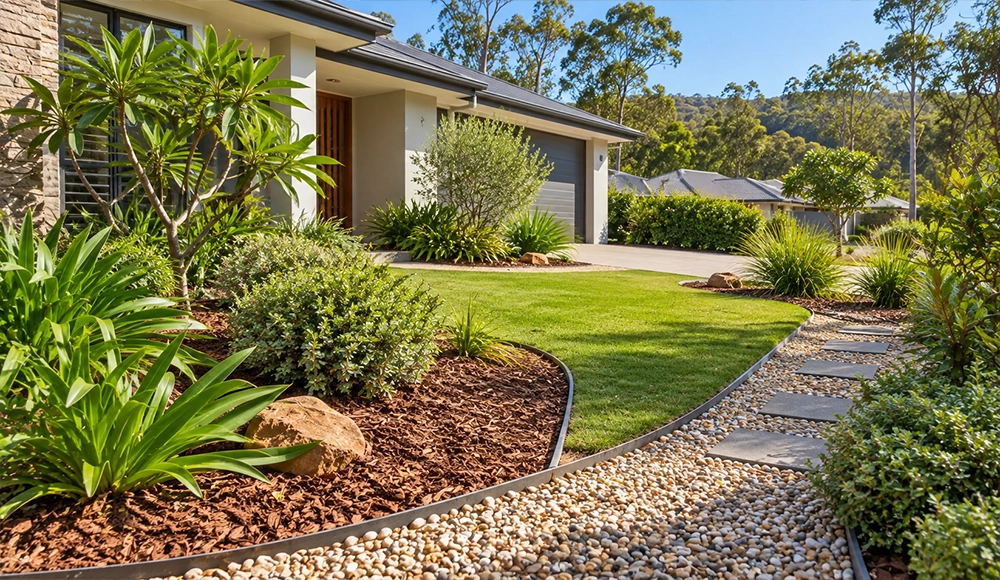
Two materials do it. Steel edging takes curves and sits almost invisibly, while treated pine sleepers suit straight runs and a heavier look.
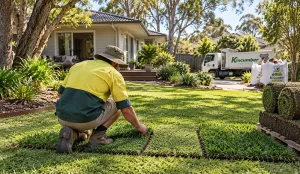
Council’s own detail is worth copying on the levels. It sets mown turf flush with the edging, and mulched areas flush with the adjacent surface. That is the bit people get wrong. Edging standing proud of the lawn catches a mower. Edging below the mulch line lets mulch wash straight over it.
Design The Watering Out
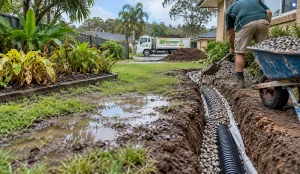
Grouping plants by how much water they need is the one planting decision that genuinely cuts work. Water a bed where everything wants the same amount once and forget it. A mixed bed, by contrast, means hand-watering the thirsty ones forever.
Local rules shape this too. Central Coast Council’s Water Wise Rules permit watering any day before 10am and after 4pm. Sprinklers are allowed as needed for 14 days after a new lawn goes in. Council is clear these are Water Wise Rules rather than restrictions. Formal restrictions begin when Mangrove Creek Dam reaches 50 per cent.
Seasonal timing helps as well. Bureau of Meteorology climate averages for Gosford name March the wettest month at 214.9mm. September is the driest at 63.0mm. So planting into autumn moisture asks far less of a hose than planting into a dry September.
Where To Start
Pick the worst-performing part of the yard rather than the most visible one. The shaded strip that never grows grass is a smaller job and a bigger relief than re-doing the front lawn.
Bring the dimensions of whatever you are converting. Then the team will work out the soil, mulch or stone volume for it. The yard at 4 Kerta Rd, Kincumber is a drive-through, so a trailer loads without reversing. Larger loads also deliver across the Central Coast. Get in touch with Kincumber Sand & Soil or call (02) 4368 1252. Open Monday to Friday 6:30am to 4pm and Saturday 6:30am to 12pm.