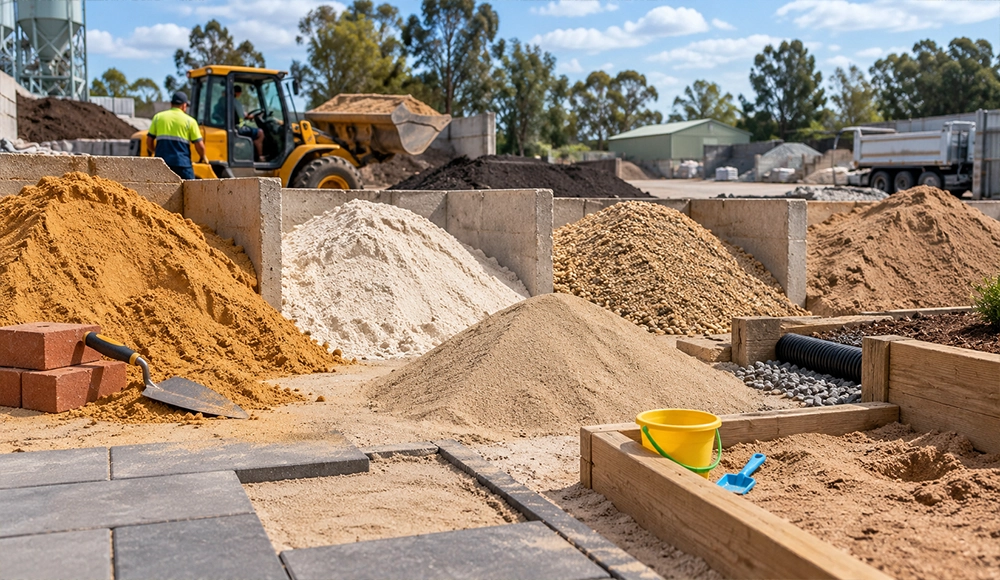
Sand Types Central Coast builders and gardeners ask about all share one problem. The names describe where the sand came from, not what it is for.
Yellow Mortar and White Mortar are both bricklaying sands. Tiling Sand is not just for tiling. Fill Sand will ruin a job it was never meant for. So here is what each of the six sands in the yard’s sand range actually does.
Why The Names Do Not Tell You Much
Sand gets named after its source or its trade, and neither tells you how it behaves. Two sands with different names can do the same job, and one sand can suit three jobs that look unrelated.
What matters is the grain. Coarse sand drains and locks up under compaction, while fine sand packs tight and holds water. Everything below follows from that.
The Six Sands, And What Each One Does
Yellow Mortar And White Mortar
Both are bricklaying sands, quarried and screened, and the yard describes both as fatty. In bricklaying that means a sand carrying enough fine material to work smoothly under a trowel rather than running dry and crumbling.
The difference is colour, not performance. White Mortar suits a light or white mortar joint, and Yellow Mortar suits the standard look. Both come by the tonne or in 25 to 30kg bags.
Tiling Sand
Washed beach and dune sand, and the most versatile of the six. The yard lists it for plastering, rendering, tiling and grouting, and also for children’s sandpits.
That sandpit use is worth a note. Council specifies sand for its own playground softfall as certified to comply with AS4685 and AS4422, in its landscaping standard drawings. Those drawings cover public playgrounds rather than a backyard sandpit, so treat the certification as a benchmark worth asking about rather than a requirement at home.
River Sand
Coarse, free draining, washed and screened, and the yard lists it for construction and residential use. The coarse grain is the point, because it drains rather than holding water.
Council uses it in its own tree pit blends, specifying approximately 10 per cent medium river sand at 0.25 to 1.0mm in the backfill soil. That gives a sense of how little sand a soil blend needs to shift its drainage.
Fill Sand
Clean sand for fill and trenches, by the tonne only. It is the cheapest sand in the yard and the one most often misused.
Fill Sand fills a void. It is not a bedding sand, not a mortar sand and not a soil amendment. Using it where a graded sand belongs is the single most common sand mistake, because it looks the same in a trailer and behaves nothing like it.
Bulk Concrete
Not a sand on its own. It is a premixed blend of 10mm blue metal and sand with no cement added, sold by the tonne, so cement gets added on site.
That suits a footing, a post hole or a small slab where buying premixed bags would cost more. Anything structural wants an engineer’s mix rather than a guess.
Coarse Or Fine? What The Grades Actually Mean
The trade words are vague, so it helps to see the numbers behind them. Council’s soil specifications name the fractions directly: medium sand at 0.25mm, fine sand at 0.1mm and very fine sand at 0.05mm.
Its turf soil tables then set limits on the mix. Medium sand runs 20 to 40 per cent, very fine sand 5 to 15 per cent, and very fine sand plus silt and clay together must stay under 20 per cent. So the fine end is capped deliberately, because that is the fraction that packs down and stops draining.
What About Sand Under Pavers?
That is its own question and it has its own answer. Which sand is used for paving covers the bedding layer properly, including why the obvious choice is often wrong.
Worth knowing that the yard’s listed underlay for pavers is ¼ Minus (Crusher Dust), which sits in the aggregate range rather than the sand range. So a paving job may not need a sand at all.
Can You Add Sand To Garden Soil?
Sometimes, and it backfires more often than people expect. Adding sand to clay in the wrong proportion can make drainage worse rather than better.
The NSW DPIRD guide to garden soils sets out how texture governs drainage, and it is the thing to read first. Council’s own approach is instructive too: it applies sand as a surface amendment and cultivates it into the top 100mm rather than tipping it on and digging. Mixing sand with garden soil goes through when it works.
Storing A Sand Pile
Sand washes further and faster than mulch or soil, so where it sits matters more.
Keep it back from the kerb and tarp it if it has to wait. Central Coast Council’s guidance on stormwater on private property states an owner must not send sediment onto an adjoining property, and a sand pile in heavy rain is the easiest way to do exactly that.
Not Sure Which One You Need?
Say what you are building rather than which sand you think you want. Then the team can name the product, because the job decides it.
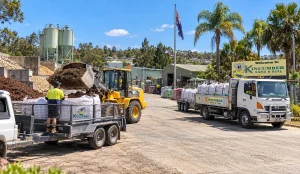
All six sit in the sand range at 4 Kerta Rd, Kincumber, by the tonne or in bags, and the yard is a drive-through so a trailer loads without reversing. Get in touch with Kincumber Sand & Soil or call (02) 4368 1252. Open Monday to Friday 6:30am to 4pm and Saturday 6:30am to 12pm.