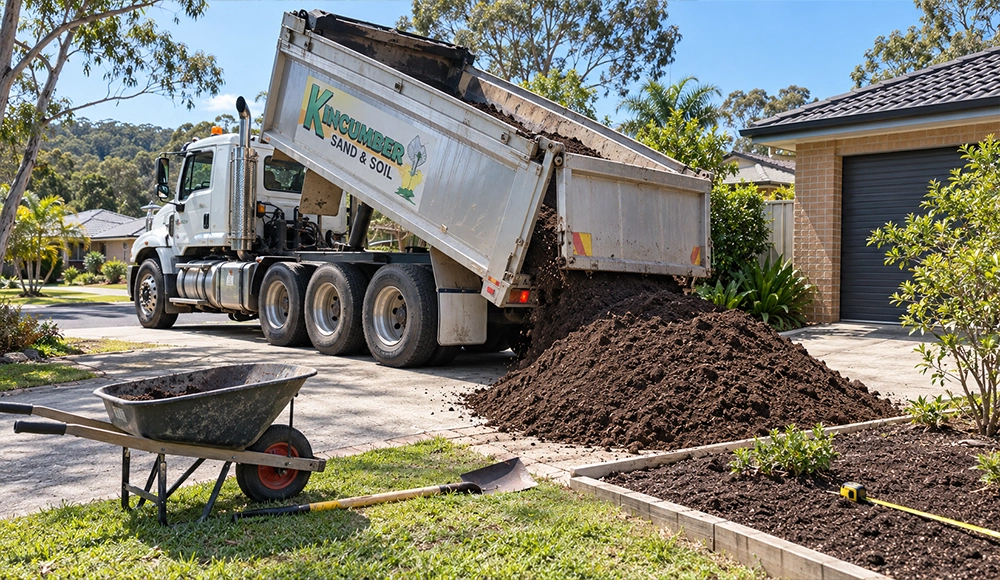
Ordering Bulk Landscape Supplies Central Coast customers get stuck on two questions. How much do I need, and where is the truck going to put it?
Both have straightforward answers, though, and getting them right before you ring saves a second delivery. So here is the volume maths, what the loads actually come as, and how to set up a drop that does not end in a wheelbarrow marathon.
How Much Do You Actually Need?
Measure first, then convert. Because guessing high wastes money, and guessing low means a second delivery fee for a quarter of a load.
The Calculation
Length by width by depth, all in metres, gives cubic metres. A bed 4 metres by 3 metres at 100mm deep works out at 4 × 3 × 0.1, which is 1.2 cubic metres.
Depth is the number people guess at, so use a benchmark. Central Coast Council’s landscaping standard drawings specify 100mm for mulch and 200mm to 300mm of topsoil for mass plantings. Those figures suit a home garden too.
Then add a margin. Soil and mulch settle, and a compacted base loses volume as it goes down, so roughly 10 per cent covers it.
Cubic Metres Or Tonnes?
That depends what you are buying, and the two are not interchangeable. Soils, mulches and some gravels sell by the cubic metre, which is a volume. Sands and quarry products sell by the tonne, which is a weight.
A cubic metre of mulch and a cubic metre of sand weigh nothing like the same. So convert with the team rather than assuming a tonne and a cubic metre are the same load. Bring the volume you calculated and they will turn it into the right order.
What Load Sizes The Yard Sells
Smaller than most people expect, which usually helps on a tight job.
Soils, mulches and some gravels come in 1 cubic metre, three quarters, a half or a quarter.
Sands and quarry products come in 1 tonne, three quarters, a half or a quarter.
Most products also come in 25 to 30kg bags, which suits one bed, a pot or a repair.
So a quarter cubic metre is a real order rather than a favour. The mulch range, the organic top dress soil range, the aggregate range and the sand range all work this way.
Trailer Or Delivery?
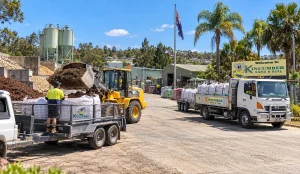
A trailer suits anything up to about a cubic metre. In addition, the yard at 4 Kerta Rd, Kincumber is a drive-through, so a trailer loads and leaves without reversing. Past that, a tipper costs less than three trips.
What A Trailer Can Legally Carry
Less than most trailers physically hold, and that is the trap. Transport for NSW guidance on towing a trailer or caravan states the loaded mass of the trailer must not exceed the lesser of four figures:
- Towbar and coupling rating.
- The vehicle’s maximum towing capacity.
- Whatever the trailer itself is rated to carry.
- Maximum rated carrying capacity of the tyres.
So the lowest of those four is the real limit. A trailer rated to carry a tonne behind a car rated to tow 600kg is a 600kg trailer.
Brakes come into it as well. That same guidance sets no brake requirement up to 750kg, brakes on both wheels of at least one axle from 751kg to 2,000kg, and brakes on all wheels from 2,001kg to 4,500kg. Anything over 2.0 tonnes gross trailer mass also needs an automatic breakaway system.
When The Manufacturer Gives No Figure
There is a fallback, and it is conservative. Where the vehicle manufacturer has not specified a maximum towing mass, Transport for NSW puts it at one and a half times the unladen mass of the towing vehicle if the trailer has working connected brakes, or the unladen mass of the towing vehicle if the trailer needs no brakes.
However, check the owner’s manual first. Where the manufacturer does give a limit, that limit applies and should not be exceeded.
Where The Pile Goes
Decide before the truck arrives, not while it is idling in the street. A tipper needs headroom and a clear run, so a low branch, a narrow gate or a parked car can turn a delivery into a return trip.
So put the drop as close to the work as the truck can safely reach. Every metre saved is a wheelbarrow trip you do not make, and that is the part of the job that actually hurts.
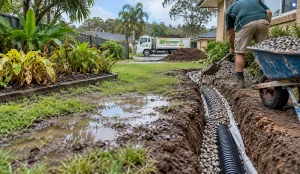
Keep it off the gutter, too. Central Coast Council’s guidance on stormwater on private property states an owner must not divert, redirect or concentrate the flow from its natural path onto neighbouring properties, and must not send sediment onto an adjoining property. A pile of soil on a driveway in heavy rain does both. NSW EPA guidance on stormwater covers what may and may not go into the system.
So tarp a pile that has to sit, and keep it back from the kerb.
Timing The Drop
Order against the stage of the job rather than the whole job. Material sitting on site for three weeks takes the rain, the foot traffic and the wind.
Weather matters more here than people allow for, because local rainfall is not evenly spread. Bureau of Meteorology climate averages for Gosford name March the wettest month at 214.9mm and September the driest at 63.0mm, against an annual mean of 1,325.3mm. A soil delivery the day before a wet week gives you mud rather than a garden bed.
Running a bigger job across several stages? The backyard order of works sets out which load should land when.
Ready To Work Out A Load?
Bring the measurements and the depth you want, and say whether you are towing or want it delivered. Then the team can sort the quantity, the unit and the drop in one conversation.
Deliveries run across the Central Coast on the yard’s own tipper trucks. Get in touch with Kincumber Sand & Soil or call (02) 4368 1252. Open Monday to Friday 6:30am to 4pm and Saturday 6:30am to 12pm.