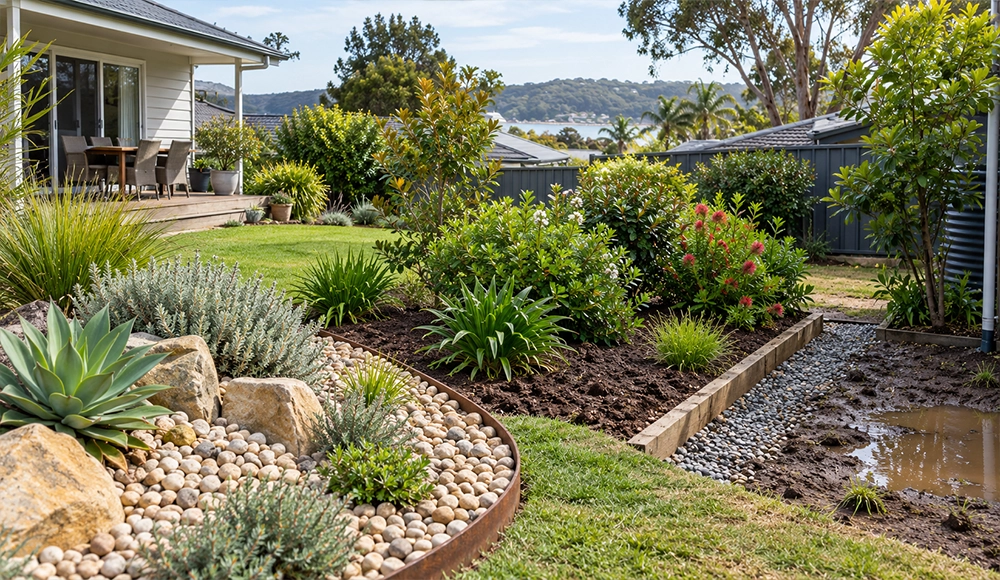
Coastal Garden Soil Central Coast conditions change street by street. That is why advice working at one house fails three suburbs away. A block at Copacabana facing open surf and a block on the clay behind Erina are not the same garden.
Three conditions do most of the damage. Salt-laden wind, sand that drains too fast, and clay that will not drain at all. Work out which one you have and the rest follows, starting with the right soil blend.
What The Ground Is Actually Doing Here
Soil varies more across the Central Coast than most regions, and there is a dataset that maps it. Soil Landscapes of the Gosford-Lake Macquarie 1:100,000 Sheets comes from the NSW Department of Climate Change, Energy, the Environment and Water. It provides an inventory of soil and landscape properties for the area, and it identifies the major soil and landscape qualities and constraints.
It is a planning dataset rather than a gardening guide, so it will not tell you what to plant. What it does show is that the soils here group into distinct units, each with different management requirements. That is the reason one neighbour’s approach does not transfer.
For the practical side, the NSW DPIRD guide to garden soils covers how texture governs drainage and nutrient holding. That is the single most useful thing to understand before buying anything.
Three Conditions That Decide What Works
Salt-Laden Wind
The condition most people underestimate, because it damages materials as well as plants. Wind carries salt inland well past the beachfront, and it lands on everything.
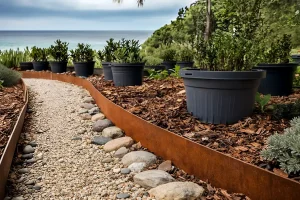
It changes one material choice outright. BlueScope’s technical bulletin on REDCOR weathering steel advises against weathering steel in marine environments with high salt deposition rates. It adds that a workable proximity to marine influence depends on wind direction and strength, the type of marine influence and local topography. So an exposed block deserves a conversation before ordering steel edging.
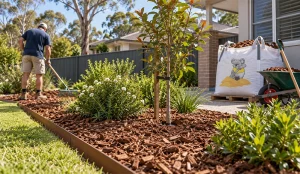
Mulch matters here too. A light bark blows off an exposed bed, which is why stone often wins on a coastal block.
Sand That Drains Too Fast
Common on the blocks nearer the water, and it fails in a way people misread. Water runs straight through, nutrients go with it, and plants look thirsty a day after rain.
Sandy soil needs organic matter rather than more sand. Compost and a blended soil hold moisture and give the sand something to bind to. That improvement needs repeating, though, as the organic content breaks down.
Clay That Will Not Drain
The opposite problem, common further inland. Clay particles pack tight, so water sits on top and roots sit in it.
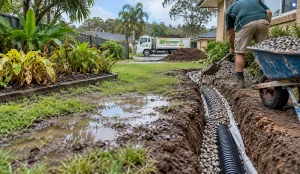
Gypsum helps the particles clump into larger crumbs, and organic matter keeps the structure open. Where a bed stays wet whatever goes into it, the fix is drainage rather than soil. Garden drainage solutions covers the three options properly.
Does Adding Sand Fix Clay?
Not reliably, and it can make things worse. Adding sand to clay in the wrong proportion fills the gaps rather than opening them. That is the opposite of the intention.
Council’s own method is instructive. It applies sand as a surface amendment, then cultivates it into the top 100mm rather than tipping it on and digging through. Mixing sand with garden soil sets out when it is worth doing. Then the sand types guide covers which sand would even be a candidate.
Matching The Material To The Condition
Four decisions cover most of it:
- Sandy soil, lead with organic matter. The organic top dress soil range is the blend that holds moisture where sand will not.
- Clay, lead with gypsum and compost, then drainage if the bed still sits wet.
- Exposed block, choose stone over light bark, because decorative pebbles stay where they are put.
- Everywhere else, get the depth right. Council’s landscaping standard drawings put topsoil for mass plantings at 200mm to 300mm, and specify 100mm of mulch. They also rule out compacting topsoil by any means beyond light firming.
That last point catches people. Treading a new bed flat undoes the air space roots need. So water it in, then top it up once it settles.
When To Work The Soil
Timing does more than product choice, and the local pattern is uneven. Bureau of Meteorology climate averages for Gosford name March the wettest month at 214.9mm. September is the driest at 63.0mm, against an annual mean of 1,325.3mm.
Storms concentrate in a known window as well. The Bureau of Meteorology explains that East Coast Lows are more common in late autumn and winter. June is the peak. So a bed built up in late autumn may get tested before anything has rooted.
Autumn still beats spring for planting, because the soil holds moisture. Just get the drainage sorted before the wet arrives rather than after.
Work Out What You Have First
Bring a photo of the bed and a note on how long water sits after rain. Say roughly how exposed the block is, too. Then the team can say which soil, which mulch and how much of each.
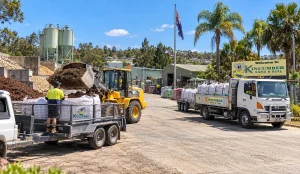
The yard at 4 Kerta Rd, Kincumber carries the soils, the mulch range and the stone for all three conditions. Because it is a drive-through, a trailer loads without reversing. Get in touch with Kincumber Sand & Soil or call (02) 4368 1252. Open Monday to Friday 6:30am to 4pm and Saturday 6:30am to 12pm.